
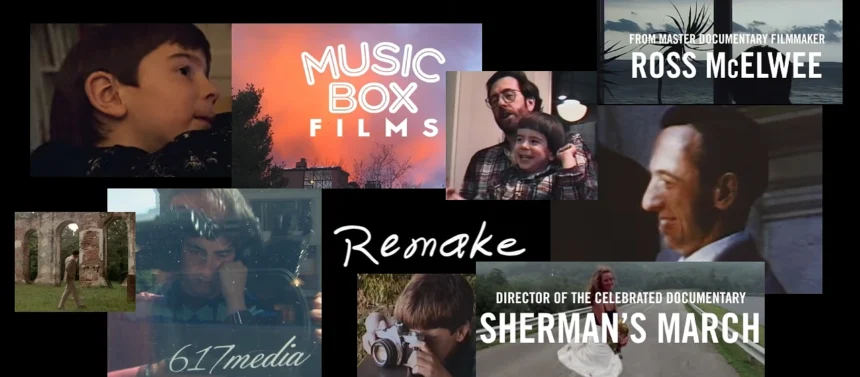
There is a film inside Remake that was never made. Hollywood spent years trying to turn Sherman’s March into a fiction feature, the project stalled, and Ross McElwee has built his latest documentary out of what was left behind, which turns out to be far more than an anecdote about the industry.
That abandoned adaptation is the film’s method as much as its subject. McElwee returns to his own archive intending to remake something and finds that the footage will not sit still for him. What begins as a filmmaker revisiting his best-known work becomes a father going back through decades of images of his son, Adrian, who died of a fentanyl overdose after years of bipolar illness and addiction that began with OxyContin.
It won the Golden Globes Impact Prize for Documentary at Venice last year, playing out of competition, and later took the Beeld & Geluid ReFrame Award at IDFA for its use of archival material. The second prize is the more telling of the two, because the archive is not a resource here so much as the thing under examination.
The Camera Was The Relationship
McElwee has always worked handheld and always turned the lens on his own family, and Remake trades on the intimacy that decades of that practice have built up. Weddings, arguments, the quiet moments where a family begins to come apart. The viewer sits inside these rather than watching them.
Adrian appears first as a boy, fishing, quick and funny and entirely present. Those early images do the cruellest work in the film, because McElwee keeps cutting from them to the young man in his twenties, and the gap between the two is not something the edit can close.
The questions that opens up are the ones McElwee cannot leave alone. Does a person become a character once there is enough footage of them? Can anyone be known that thoroughly and still be known at all? He seems to conclude that he understood his son less the older Adrian became, which is a devastating thing for a documentarian to admit about his own subject.
Grief Rewrites The Back Catalogue
Remake keeps stepping away into McElwee’s earlier films, In Paraguay and Sherman’s March among them, and those detours offer a few minutes of relief before the weight returns.
They also do something stranger. Watched from the other side of Adrian’s death, the older work changes meaning, and Photographic Memory in particular now plays like a warning nobody could have read at the time. That is the film’s central insight about art and life, arrived at through structure rather than stated.
Charleen Swansea supplies the line that frames it, pulled from Sherman’s March footage, where she tells McElwee that this is not art, this is life. Forty years on he is still trying to find the seam between the two, and Remake suggests there may not be one.
Adrian was doing the same work from the inside. He had begun a film of his own about his addiction and his bipolar diagnosis, and McElwee incorporates it, narrating over his son’s own images. Those passages are the hardest in the documentary and they are also its strongest argument, because they show two people reaching for the same tool and using it to say completely different things.
Where It Lands
The anger is unmistakable and McElwee does not tidy it away, whether it is aimed at whoever supplied the fentanyl or at himself for failing to prevent any of it.
Comparisons with A Beautiful Boy will follow the film around, and they undersell it. That drama stays on the surface of addiction. Remake goes underneath by turning the question on the filmmaker, asking what it means to have spent a lifetime pointing a camera at the people you love and to be left holding only the footage.
The closing movement is the best of it. McElwee describes returning again and again to Adrian’s images and his own, wondering whether repetition is slowly turning his son into a fiction. Three words carry the ending. I keep watching.
Remake opens in UK and Irish cinemas on 25 September 2026.